
A typical day for the Ormoc Marine Mammal and Reptile Rehabilitation Center.
In Ormoc[1], a green sea turtle named “Kan,” (shortened “Pawikan”––common local name for sea turtles in the Philippines) was found floating just off the coast, paralyzed and unresponsive. When Irish Gomez Belmonte, Senior Agriculturist of the City Government of Ormoc was called in, she was seven months pregnant. With no time to spare, she brought Kan to the local hospital for what would become one of the city's most unusual emergency room visits.
As Irish walked into the ER cradling the turtle, the hospital staff rushed toward her, assuming she was the one in distress. "They thought I was about to give birth," she laughs. "But I said, 'No, it's not me—it's the turtle.'"
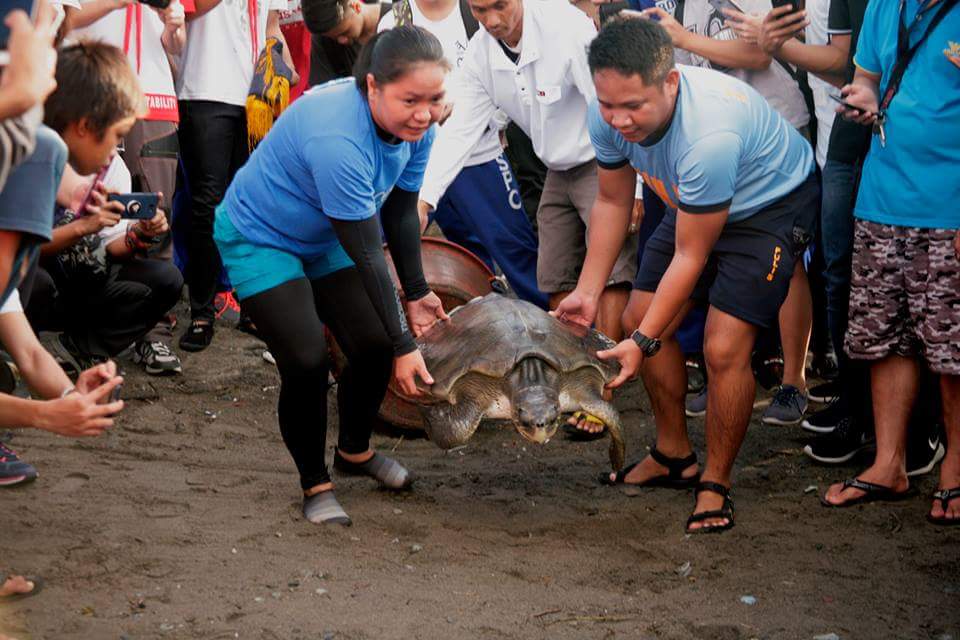
Monitoring “Kan,“ the rescued green sea turtle prior to release back to the sea. Photo courtesy of City Government of Ormoc
Kan would receive X-ray support at that time and eventually survive to be released. But everyone knows that that day would plant the seeds of a local movement that would bring together science, compassion, and community responsibility.
Irish recalls how that light-hearted confusion gave way to something more profound.
Reflecting on this year's United Nations World Oceans Day theme: Wonder: Sustaining What Sustains Us, experience from the coastal city of Ormoc reminds us that the ocean is our world's greatest wonder, and its health is interwoven with how we care for communities, ecosystems, and each other.
Wonder awakens us, but how might we sustain our response?
Wonder as Recovery: Building the Ormoc Marine Rehabilitation System
While there have been several initiatives in the past, Ormoc City's marine protection efforts formally began in 2017 at the remarkable rescue story of “Kan.” By 2019, they had taken shape as the Ormoc Marine Mammal and Reptile Rehabilitation Center, housed under the City Agriculture Department's Fisheries Division and backed by local ordinance. What started as a makeshift recovery in tarpaulin-lined pools grew into a structured program with a dedicated onshore facility, an offshore expansion, and a diagnostic laboratory.
Ormoc is now home to the region's only dedicated marine rehabilitation team, with trained responders not just in the city but across Leyte, Biliran, and Southern Leyte. At least sixty marine turtles, dolphins, and other marine species have since been rescued, rehabilitated, and, where possible, released. The work is collaborative, anchored by local government, and supported by a growing network that includes the academe, civil society, and passionate marine experts, veterinarians, specialists, and diving hobbyists.
“The love story we shared—here in the Philippines and across the globe—was born out of a heartfelt initiative to protect our most vulnerable species. What began as a simple act of compassion has grown into a movement, evolving into a sanctuary where these gentle creatures receive the care they so deeply deserve.
As Ormocanons, we are called to be stewards of these animals, for we are all part of one interconnected web of life. Ormoc is not just for Ormocanons—it is home to all who dwell in her, human and animal alike. And as human beings, it is our sacred responsibility to protect the natural beauty that surrounds us—not only for ourselves, but for every living creature that shares this Earth with us.”
- Mayor Lucy Torres Gomez, City Government of Ormoc[VA2] [ED3]
Today, the center uses mobile X-rays, morphological assessments, behavioral therapy, and tagging systems to aid recovery. But beyond the tools and techniques, what stands out is how the program has become a community symbol. The animals saved often arrive with injuries from ghost nets, plastic ingestion, or trauma, but leave bearing names and stories—each one an embodiment of resilience and care.
Wonder as System, Circularity and Community: Closing Loops, Strengthening Networks
Thorough examination of the carcasses of marine animals often reveals plastic debris in the stomachs of stranded animals—this further reinforces the urgency of the need for more extensive efforts. From marine rehabilitation to upstream interventions, Ormoc's realization that their conservation work should link with what happens in the ridge to what ends up on its reefs: recovery alone won't solve the deeper issue, we need to look not just at how waste is collected or disposed, but at how it’s created in the first place.
So it turned to circularity.
Ormoc is among the pilot cities of the Green Local Government Units (LGUs) Project, jointly led by the Department of the Interior and Local Government and UNDP under the European Union-funded Green Economy Partnership with the Philippines[2], spearheaded by the Department of Environment and Natural Resources (DENR). The project aims to support local governments to accelerate their transition to inclusive, climate-smart circular economies.
UNDP, together with Mayor Lucy Torres Gomez and representatives from the City Planning & Development Office, City Environment & Natural Resources Office and Sangguniang Bayan during the presentation of the city’s CE portfolio. Photo courtesy of the City Government of Ormoc
With support from this project, Ormoc City has developed its Circular Economy (CE) Portfolio: Sustainable Holistic Innovation for Circular Economy in Ormoc City (#SHInE Ormoc––a robust roadmap that guides how the city redesigns systems across three priority areas: plastics circularity and waste-to-resource systems, organics circularity, and sustainable urban development and green tourism.
The CE Portfolio reflects a whole-of-city transition: from upstream behavior change and localized livelihood models to downstream waste recovery infrastructure and policy reform. It integrates cross-cutting themes such as policy development, green procurement, education, and community-based innovation, creating practical entry points for circularity that resonate with everyday life in Ormoc.
And while it may seem far removed from a turtle rescue, this portfolio lays the groundwork for long-term protection of Kan’s habitat—and countless others.
Education is core to this work. The city coordinates with government agencies to integrate marine protection into elementary school curricula. A major anchor of #SHInEOrmoc is the establishment of the Ormoc Circular Economy Research and Development (R&D) Center. This facility will not only serve as an academic hub for CE-aligned curricula and student engagement but also as a platform for applied research on microplastics, regenerative agriculture, greenhouse gas inventories, and circular livelihoods. It connects the city with knowledge partners and creates mechanisms for sustained knowledge-sharing with other LGUs and grassroots communities.
The City also has put in place a solid waste ordinance as well as plastic regulation measures to prevent marine litter at the source.
Trash traps are set up in strategic locations of the city. Photo courtesy of City Government of Ormoc
As an additional measure, trash traps have been situated in riverways to intercept waste before it reaches Ormoc Bay. Since its installation in 2024, a total of at least 1,194 kg of compostable waste, 591 kg of residual waste, and 15 kg of recyclables were collected from the trash traps. Waste intercepted by these traps, along with the other collections from the city, was brought to the city's eco-waste center to reinforce upcycling and composting measures.
Leyte Electric Cooperative (LEYECO-V) sustainability banner––an artistic output during one of the events of the City Government of Ormoc (left); Upcycled ecobricks by the Mas-Green Eco-Waste Pickers Association in the city’s eco waste center. Photos courtesy of UNDP, Leah Payud
Livelihood initiatives also support these goals. Upcycling programs transform plastic into usable goods, while sachet-free models and community refilling stations help reduce household dependence on single-use products. Resource mobilization efforts also help sustain the center's operations, ensuring continuity even outside of annual budget cycles.
Inclusivity is at the core. Gender equality, disability inclusion, and the recognition of often-overlooked actors in circular systems are not just principles—they are practices in Ormoc’s approach. These are most evident in the way the city collaborates with women fisherfolk, youth volunteers, and frontline solid waste responders to ensure that no one is left behind in the transition to a greener economy.
These commitments come alive along the coast. Regular campaigns, training sessions, and rescue simulations are held with fisherfolk, youth groups, and women’s associations. Local volunteers now include divers, teachers, mothers, and students—many of whom had never seen a dolphin up close but now know how to rescue one. In these moments, circularity becomes more than a strategy—it becomes shared responsibility and lived experience.
Through this collaboration under the Green LGUs Project, Ormoc is set to scale marine litter prevention efforts, align tourism and fisheries practices with sustainability goals, and deepen its multi-layered response to a shared crisis. Waste is reduced. Systems are reinforced. And the wonder that drives people to act is met with the tools and frameworks to make that action sustainable.
Wonder Isn't Just a Feeling—It's a Force
What began with one sea turtle has evolved into a cross-sector, community-centered model for marine stewardship. Ormoc is demonstrating that saving marine life requires more than compassion—it involves coordination, courage, and continuity.
Aerial shot of the Ormoc Mangrove Ecopark. Photo courtesy of City Government of Ormoc
The city is building something bigger than a response mechanism, from its campaigns, trash traps, and turtle tanks. But the work is far from over. It is cultivating a system that links upstream behavior with downstream outcomes, empowering local people to protect the biodiversity they depend on, and redefining what care for the ocean looks like in practice.
At the heart of this is a shift away from linear models of consumption and disposal. Ormoc's circular strategy embraces the "10R" strategies of circular economy: Refuse, Rethink, Reduce, Reuse, Repair, Refurbish, Remanufacture, Repurpose, Recycle, and Recover.
Irish, who brings with her, decades of experience in Ormoc City, is both a witness to and an actor in this significant shift.
Irish Gomez Belmonte, Senior Agriculturist of the City Government of Ormoc. Photo courtesy of the City Government of Ormoc
"Kan taught us that every life is worth saving," says Irish. "However, rescuing alone is not enough. We must reimagine our relationship with the ocean and ensure that waste does not enter its water. This is why embracing a circular economy is crucial and should be a practice adopted by everyone."
As the world gathers to celebrate World Oceans Day, Ormoc's message resonates clearly: to sustain the ocean, we must awaken our sense of wonder—but pair it with the structures, partnerships, and practices that make protection possible.
Ormoc City hosted training sessions on marine conservation. Photo courtesy of the City Government of Ormoc
If the ocean sustains life, then our systems must sustain the ocean.
[1] About Ormoc City
Ormoc City is a first-class, independent component city and a key regional center in the Province of Leyte, Eastern Visayas, Philippines. It is a coastal city, considered an economic, cultural, commercial, and transportation hub of Western Leyte. It has rich natural resources, including Ormoc Bay, the Amandiwin mountain range, an intricate network of rivers and streams, and vast, productive agricultural lands. Sugar cane, rice, and pineapple are the primary agricultural products. The city has a population of 230,998 with total households at 50,341 according to PSA 2020 Census, covering a land area of 46,430 hectares with 85 barangays (6 urban, 16 coastal, 63 rural).
[2] About the EU-PH Green Econom Partnership
Funded by a €60 million (₱3.67 billion) grant from the European Union, the EU-GEPP will run from 2023–2028 with the Department of Environment and Natural Resources (DENR) as lead implementing agency, in collaboration with the Department of Trade and Industry, Department of Energy, and the Department of the Interior and Local Government. The programme supports circular economy, renewable energy, waste reduction, and climate resilience. Co-funded by Germany’s development agency GIZ, it is implemented by UNDP Philippines, Expertise France with the Global Green Growth Institute (GGGI), and the International Finance Corporation (World Bank Group). EU-GEPP is part of the European Union’s Global Gateway initiative, which fosters green transition and sustainable investments through trusted, inclusive partnerships.
About Specific Objective 2 (Green LGUs)
Specific Objective 2 (Green LGUs) is a key component of the EU–Philippines Green Economy Programme that supports cities and municipalities in advancing inclusive, locally led circular economy (CE) transitions. Co-led by the Department of the Interior and Local Government (DILG) and implemented by UNDP Philippines, the project empowers local actors to co-create circular solutions that reduce waste, regenerate ecosystems, and improve everyday systems through sustainable, community-rooted practices. It works to strengthen capacities, develop enabling policies, and unlock support across sectors—including local governments, civil society, the private sector, and marginalized groups—ensuring that circularity becomes not only practical, but part of the norm.