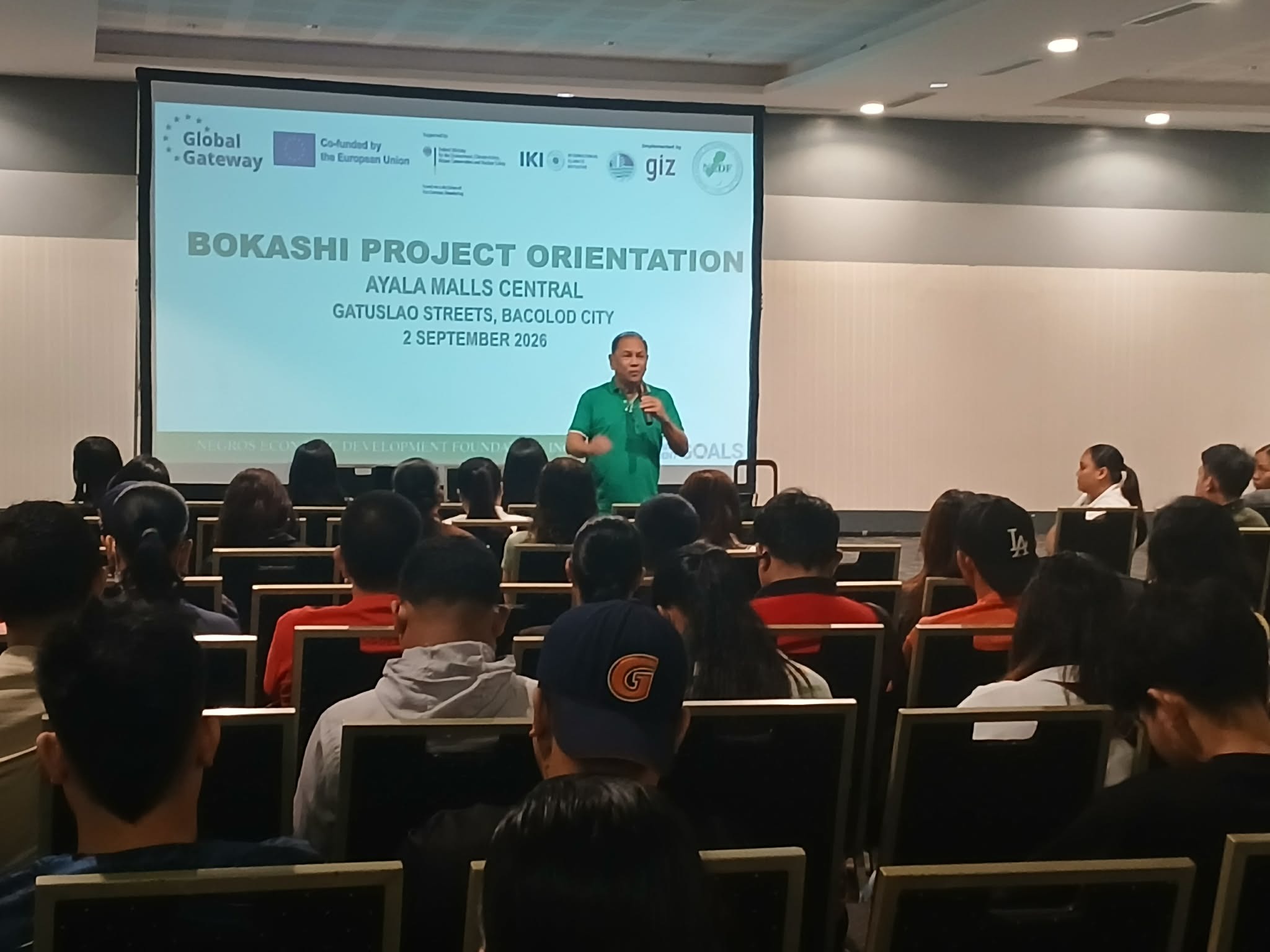
In collaboration with the European Union–Philippines Green Economy Partnership, around 70 representatives from restaurants, food stalls, and coffee shops participated on 02 September 2026 in an orientation on practical approaches to reducing food waste and recovering organic resources.
Led by the Negros Economic Development Foundation Inc. (NEDF), the Bokashi Project aims to engage households and commercial establishments in more sustainable food-waste management through Bokashi – an anaerobic, oxygen-free composting method that uses a mix of microorganisms that breaks down food scraps rapidly into a nutrient-rich soil enhancer that helps support the healthy growth of plants and vegetables.
This project is supported by the European Union-Philippines Green Economy Partnership, a P3.67 billion (€60 million) priority programme of the European Union under its Global Gateway initiative — the European strategy engaging with partners globally and promoting investments around shared priorities such as the transition to a green economy. Led by the Department of Environment and Natural Resources (DENR), this programme links European and Filipino partners from the private sector and local government to foster a circular economy while sustaining economic growth that benefits all Filipinos. The Policy and Alliances component of the programme—co-funded with a €12 million grant from the European Union and a €1 million contribution from the International Climate Initiative of the German Federal Ministry for the Environment, Climate Action, Nature Conservation, and Nuclear Safety and implemented by GIZ Philippines and DENR-Environmental Management Bureau—supports policy development and fosters strong partnerships.
During the orientation, NEDF Executive Director Gerry Ganaba highlighted the important role of food businesses in supporting Bacolod City’s ambition to become a model for circular economy approaches in the Philippines.
Bokashi Project Team Lead Jolly Mider introduced Bokashi as a simple way to turn food scraps into a useful resource rather than waste. For restaurants and other food businesses, it provides a practical way to manage food waste while reducing the volume of organic waste sent for disposal. The project supports a broader shift toward treating biodegradable waste as a resource, with potential benefits including reduced landfill-bound waste, improved soil health, and opportunities to support urban agriculture and local food production.
The orientation also explored potential partnership arrangements with Ayala Malls Capitol Central Bacolod, led by Ms. Maphis S. Peñaredondo, Soft Services Associate Manager/Sustainability Lead, and Ms. Sharon V. Ciocon, General Manager, to support the adoption of Bokashi among participating establishments.
The collaboration aims to demonstrate how practical food-waste solutions can be integrated into business operations and contribute to more circular waste management in Bacolod City. Moreover, the project will promote investment-ready solutions, connecting European organizations with local stakeholders to support the adoption of Bokashi into farms and communities and scaling of sustainable food-waste management solutions in the Philippines.