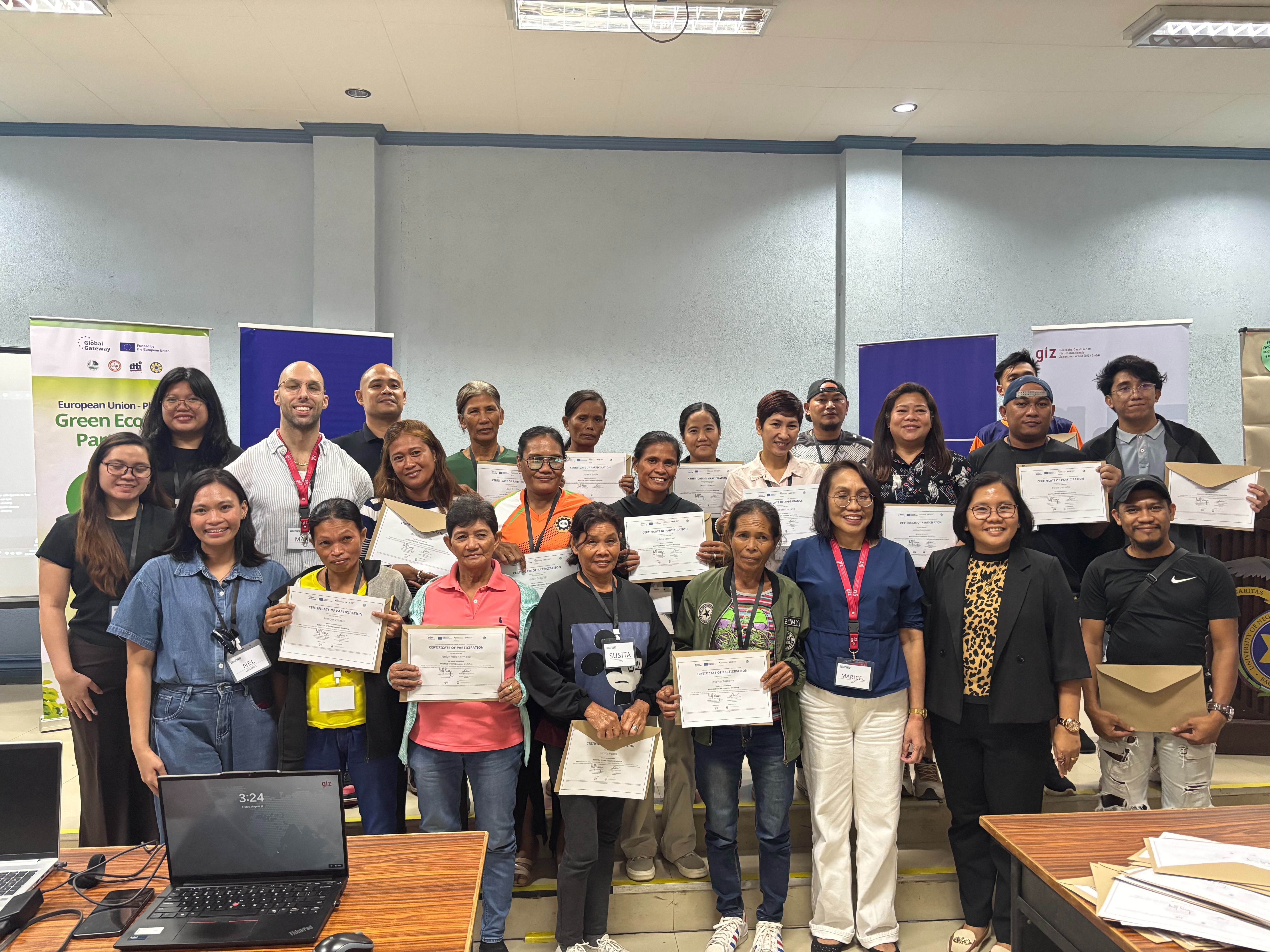
Supported by the European Union-Philippines Green Economy Partnership, the University of Negros Occidental–Recoletos (UNO-R) gathered stakeholders from the Bacolod City in an inception workshop to establish the technical and collaborative foundation for the BIOCYCLE EPR-PH project.
The BIOCYCLE EPR-PH project aims to address the growing challenge of electronic waste (e-waste) in Bacolod City. Through the E-Waste Analysis and Characterization Study (E-WACS), the project seeks to generate local data to support better e-waste management and circular economy solutions.
This initiative is under the European Union - Philippines Green Economy Partnership, a P3.67 billion (€60 million) priority programme of the European Union under its Global Gateway initiative - the European strategy engaging with partners globally and promoting investments around shared priorities such as the transition to a green economy. Led by the Department of Environment and Natural Resources (DENR), this programme links European and Filipino partners from the private sector and the local government to foster a circular economy while sustaining economic growth that benefits all Filipinos. The Policy and Alliances component of the programme – co-funded with a €12 million grant from the European Union and a €1 million contribution from the International Climate Initiative of the German Federal Ministry for the Environment, Climate Action, Nature Conservation, and Nuclear Safety and implemented by GIZ Philippines and DENR-Environmental Management Bureau – supports policy development and fosters strong partnerships. The two-day workshop brought together project partners from the University of Kassel (UniKass), University of Negros Occidental–Recoletos (UNO-R), and Deutsche Gesellschaft für Internationale Zusammenarbeit (GIZ), alongside key local and national stakeholders, including the Bacolod Environment and Natural Resources Office (BENRO), City Planning and Development Office (CPDO), DENR–Environmental Management Bureau (DENR-EMB), Barangay Felisa, and representatives from the private sector, e-waste industry, local businesses, communities, and other relevant institutions.
“Through the inception workshop, we are bringing together the knowledge, experience, and perspectives of different stakeholders to build a shared understanding of Bacolod City’s e-waste landscape. This collaboration is an important first step toward generating reliable local data and developing practical, evidence-based solutions that can strengthen e-waste management and advance circularity in the city,” said Dr. Marisa B. Petalla, Team Leader and Research Director of the University of Negros Occidental–Recoletos (UNO-R).
Moving beyond project introduction, the workshop served as a working platform to examine the existing electronic waste landscape in Bacolod City. Participants engaged in stakeholder mapping, e-waste supply and process-flow mapping, field validation planning, technical discussions, and capacity-building activities to identify how e-waste is generated, collected, transferred, processed, and managed across different sectors. The discussions also helped identify existing practices, institutional roles, data and capacity gaps, and potential areas for coordination among government, academia, industry, communities, and other actors within the e-waste value chain.
As the project moves into its succeeding upcoming field activities, data collection, analysis, and validation, UNO-R and its partners will work toward generating the evidence and practical insights needed to help Bacolod City move from managing e-waste as a waste stream toward seeing it as an opportunity for resource recovery, innovation, green investment, and circular growth.