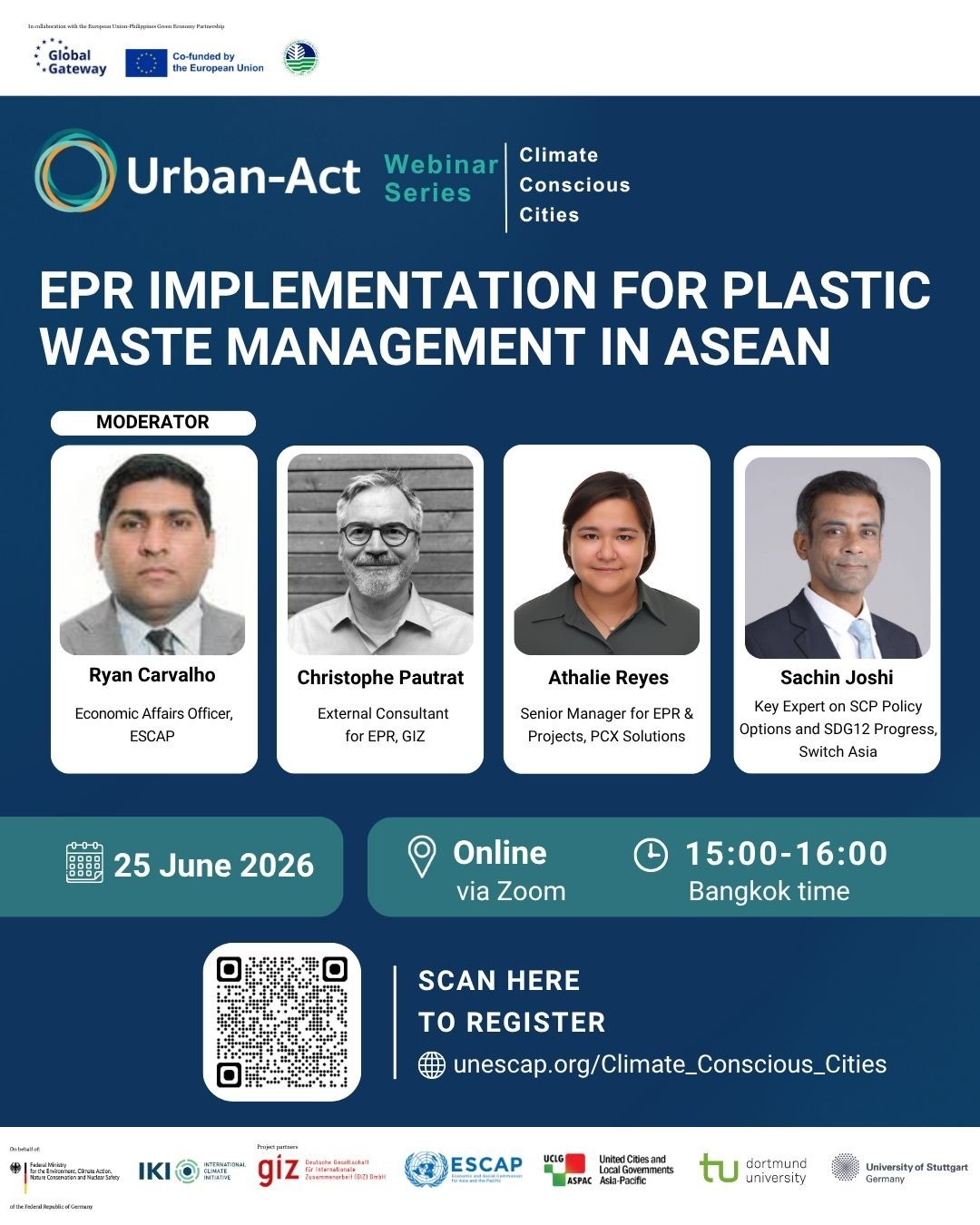
EPR Implementation for Plastic Waste Management in ASEAN
June 25, 2026
4:00 PM - 05:00 PM
Did you know that rapid urbanization, changing consumption patterns and growing volumes of plastic packaging waste are placing increasing pressure on waste management systems, public services and the environment across Asia and the Pacific? In response, countries are increasingly exploring Extended Producer Responsibility (EPR) as a key policy approach to reduce plastic leakage, strengthen resource recovery and support the transition towards a circular economy.
In collaboration with European Union-Philippines Green Economy Partnership, join us on Thursday 25 June 2026 at 15:00 (GMT+7) for the fifth session of the Urban-Act Climate Conscious Cities Webinar Series on "EPR Implementation for Plastic Waste Management in ASEAN”.
Why this matters:
Extended Producer Responsibility is a policy approach that places greater responsibility on producers, importers and brand owners for the environmental management of their products and packaging throughout their lifecycle, including collection, recovery, recycling and final disposal. For plastic packaging, EPR can help shift waste management from a system primarily financed and managed by local governments towards a more shared-responsibility model, where producers contribute to the systems and costs needed to increase recycling, reduce plastic leakage and advance circular economy approaches.
Within ASEAN, EPR is increasingly being advanced as a key instrument for sustainable plastic waste management. However, ASEAN Member States remain at different stages of implementation. While some countries have introduced EPR-related laws, regulations or pilot schemes, others are still developing the enabling policy frameworks, institutional arrangements, financing mechanisms and implementation capacity needed to operationalize EPR effectively.
This webinar will explore:
Insights from expert speakers and practitioners will highlight how EPR systems for plastic packaging are being designed and implemented across ASEAN, and how national regulations can be translated into effective local action. The session will also examine key barriers and opportunities, including policy and institutional gaps, financing needs, waste management infrastructure, implementation capacity, and the importance of multi-stakeholder collaboration across the waste management value chain.
🌏 Speakers include:
Don’t miss this opportunity to hear from experts in the EPR implementation.